Tauri usually gets compared on two numbers: it is smaller than Electron, and it is written in Rust instead of JavaScript. Both are true. Both undersell where it sits once you look past the head-to-head comparison at the whole population of desktop apps.
We track 28,690 macOS and Windows apps by reading the shipped binary, not the source repo or the marketing page. Tauri is a modest slice of that corpus at 5.7%. But it has already done something more specific than "grow": it has passed every other cross-platform or systems-language contender that isn't Electron, on both operating systems.
The ranking
Overall, Tauri sits fifth: behind native C/C++ (18.7%), native Swift/ObjC (18.5%), .NET (17.1%), and Electron (15.6%), and ahead of Qt (3.5%), Python (2.6%), Rust native (2.5%), JVM (2.5%), Flutter (2.4%), and Go native (2.4%).
Split by platform, the picture holds. On macOS, Tauri is 7.4% of the apps we track, fourth place behind Swift/ObjC, Electron, and Cocoa, and ahead of Qt. On Windows, it is 4.5%, fourth behind native code, .NET, and Electron, and ahead of Go native, Qt, and Rust native.
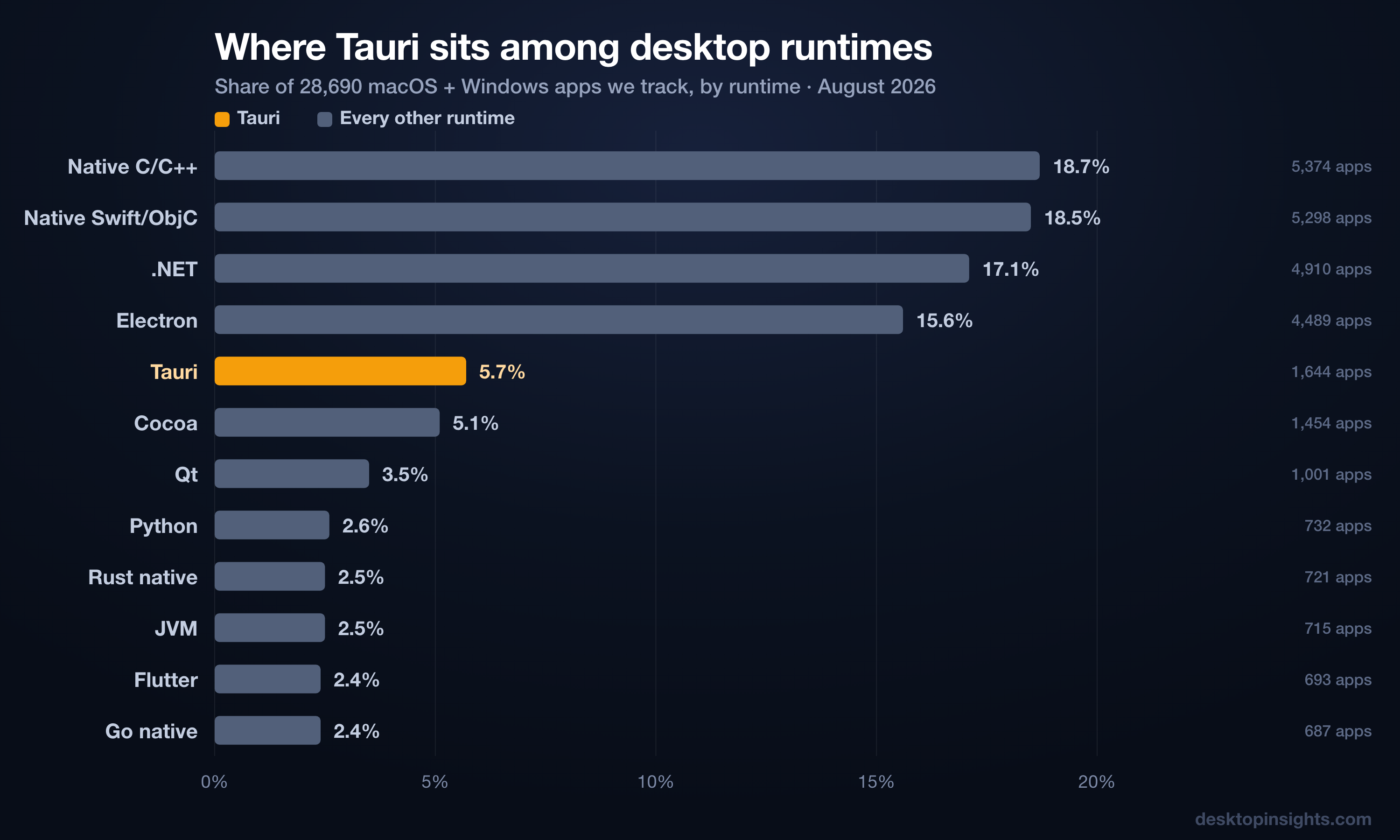
Tauri is not challenging the big four. What it has done is win the tier underneath them, the cross-platform-webview and systems-language challengers it competes against for a developer's attention.
The tradeoff that explains the share
Two numbers pull in opposite directions, and together they explain why Tauri looks the way it does.
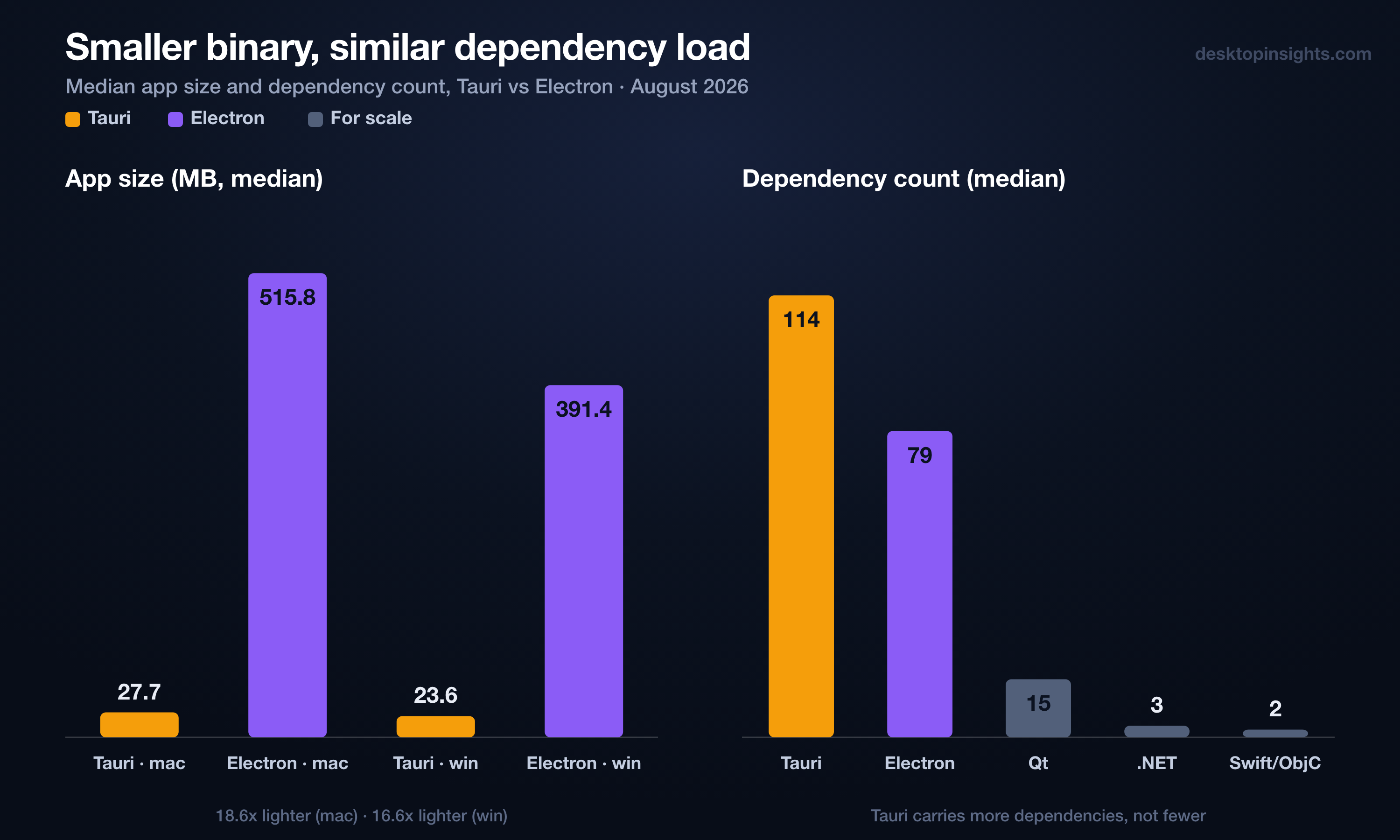
The median Tauri app on macOS is 27.7 MB. The median Electron app is 515.8 MB, about 18.6 times heavier. On Windows the gap is similar: 23.6 MB versus 391.4 MB. That is the pitch, and it is real.
The dependency count tells the other half of the story. The median Tauri app carries 114 dependencies, against 79 for Electron. Both numbers dwarf Qt (15), .NET (3), and Swift/ObjC (2). Tauri trades Chromium and Node for a webview and a Rust crate ecosystem, but the crate ecosystem has the same sprawl problem npm does. You get a fraction of the footprint, not a fraction of the supply chain.
One more thing falls out of Tauri's youth as a framework: on macOS, only 6.0% of Tauri apps still ship Intel-only, against 14.9% for Electron. Tauri's developer base largely started building after Apple Silicon became the default, so this is a fact about the corpus's age, not a claim that Tauri handles cross-compilation better.
The typical Tauri app is more popular than the typical Electron app
Every runtime has an app or two that everyone has heard of, and a long tail that nobody has. What separates them is the typical app.
Measured by our 0 to 100 popularity index, Tauri scores a median 23.0 on macOS against Electron's 12.8. On Windows it is 39.9 for Tauri against 36.2 for Electron. On macOS, the flagship tier, the mean of each runtime's ten most popular apps, sits near the ceiling of the index for both frameworks.
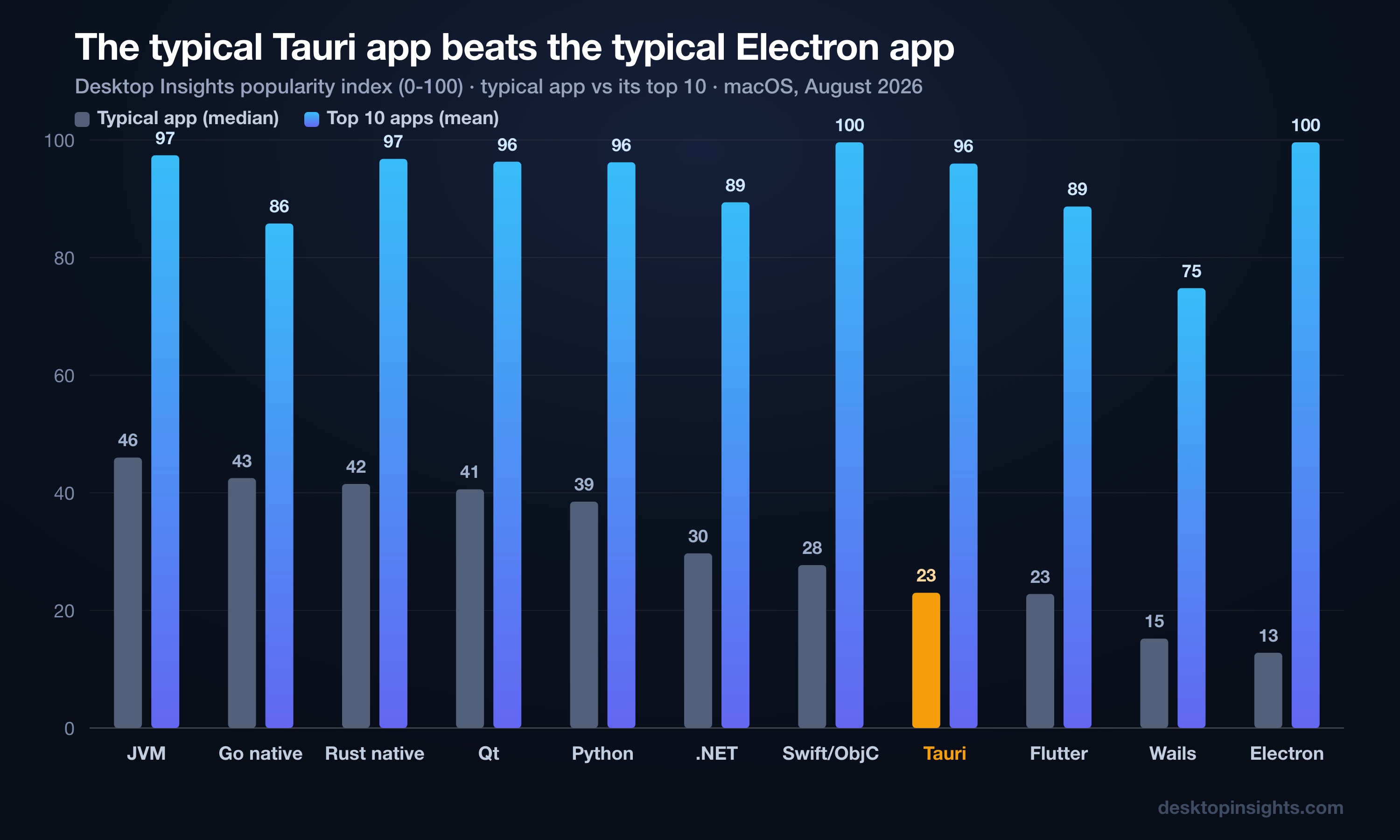
Tauri's hits on macOS are no bigger than Electron's. Its typical app is more popular on both platforms. Electron's population is older, larger, and far more heterogeneous, four and a half thousand apps ranging from Slack to abandoned side projects, so some of this is probably a younger, more selected cohort rather than the framework itself. We are reporting what we measured, not what caused it.
What's inside a Tauri app
Two structural facts about the ecosystem, both read straight from the dependency manifests of every Tauri app we track.
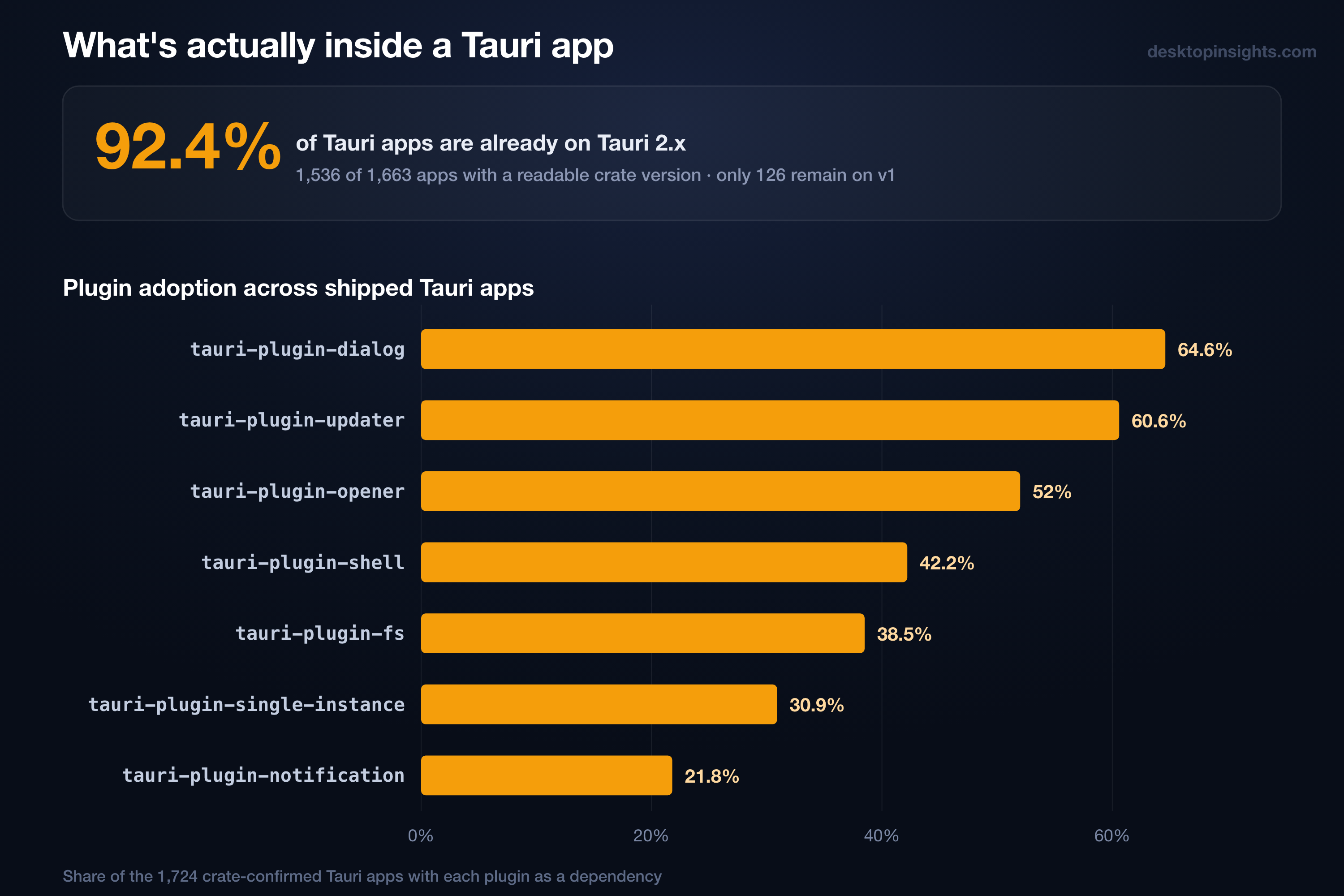
The version 1 to version 2 migration is essentially finished. Of the apps with a readable Tauri crate version, 92.4% are already on Tauri 2.x, and only 126 remain on version 1.
The plugin census shows what shipped apps reach for. tauri-plugin-dialog appears in 64.6% of apps, tauri-plugin-updater in 60.6%, tauri-plugin-opener in 52.0%. Self-updating is close to a default, not a feature, which makes sense for a framework whose distribution model is largely direct download and GitHub releases rather than an app store. Further down the list, the official persistence plugins, tauri-plugin-sql and tauri-plugin-store, show up in a small minority of apps, suggesting most Tauri developers are rolling their own storage rather than reaching for the first-party option.
Tauri's open-source repos gained stars faster than Electron's
For the subset of apps with a public GitHub repo we snapshot, we can measure something neither framework gets compared on: attention over time rather than size at a point in time.
Looking at the 273 Tauri repos and 363 Electron repos in our snapshots with at least 90 days of star history, the median Tauri repo grew its star count 33.3% over that window. The median Electron repo grew 19.75%. The gap holds across the whole distribution, not just at the middle: at the 25th percentile, Tauri is still ahead, 12.0% to 7.1%, and at the 75th percentile, 73.2% to 56.0%.
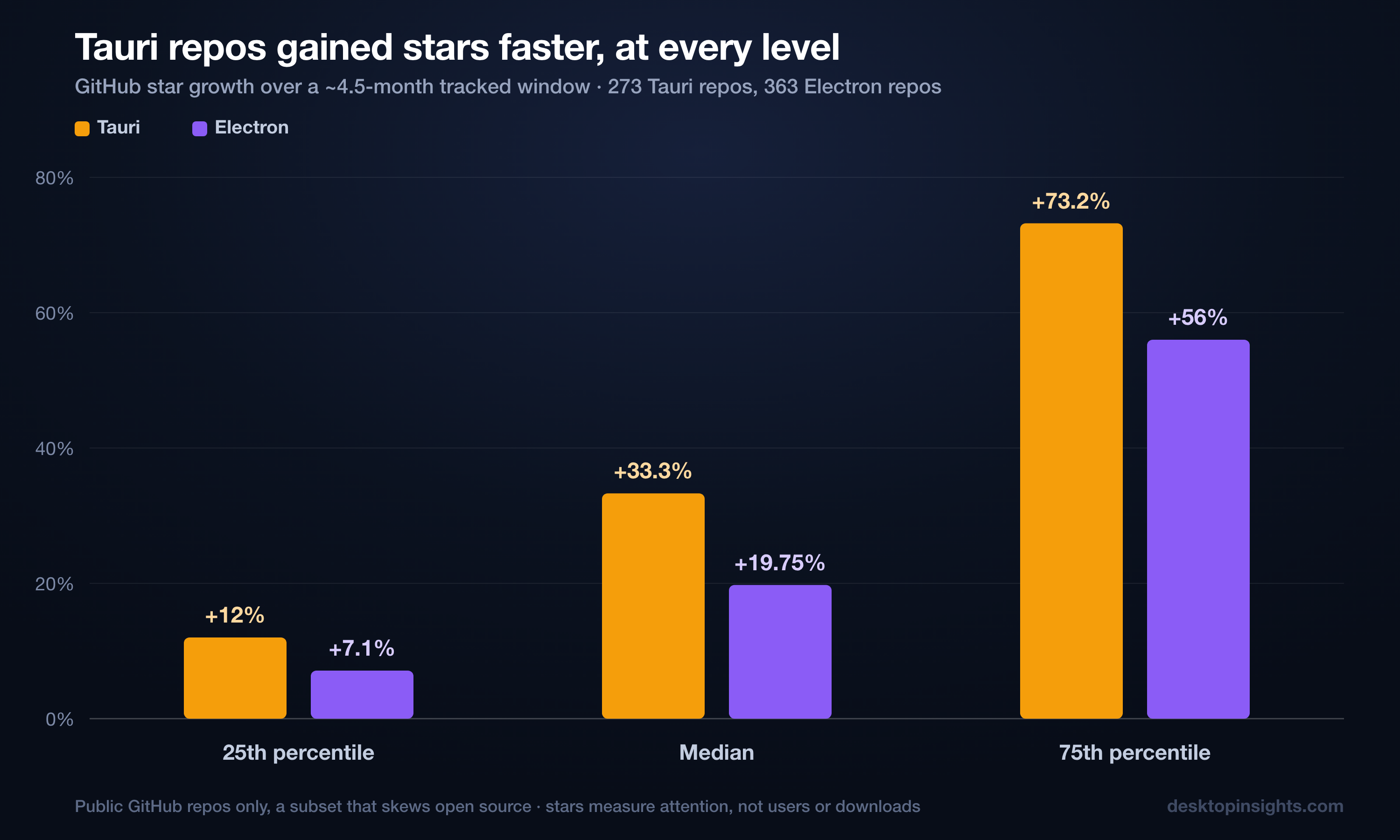
The caveats matter as much as the number. This only covers apps with a linked, actively tracked public repo, a slice that skews open source, so it says nothing about the closed-source apps in either framework. Stars measure developer attention, not users or downloads. And four and a half months is a window we happened to have, not a trend line, so read this as "in the period we measured," not "Tauri is winning."
The apps being built on it
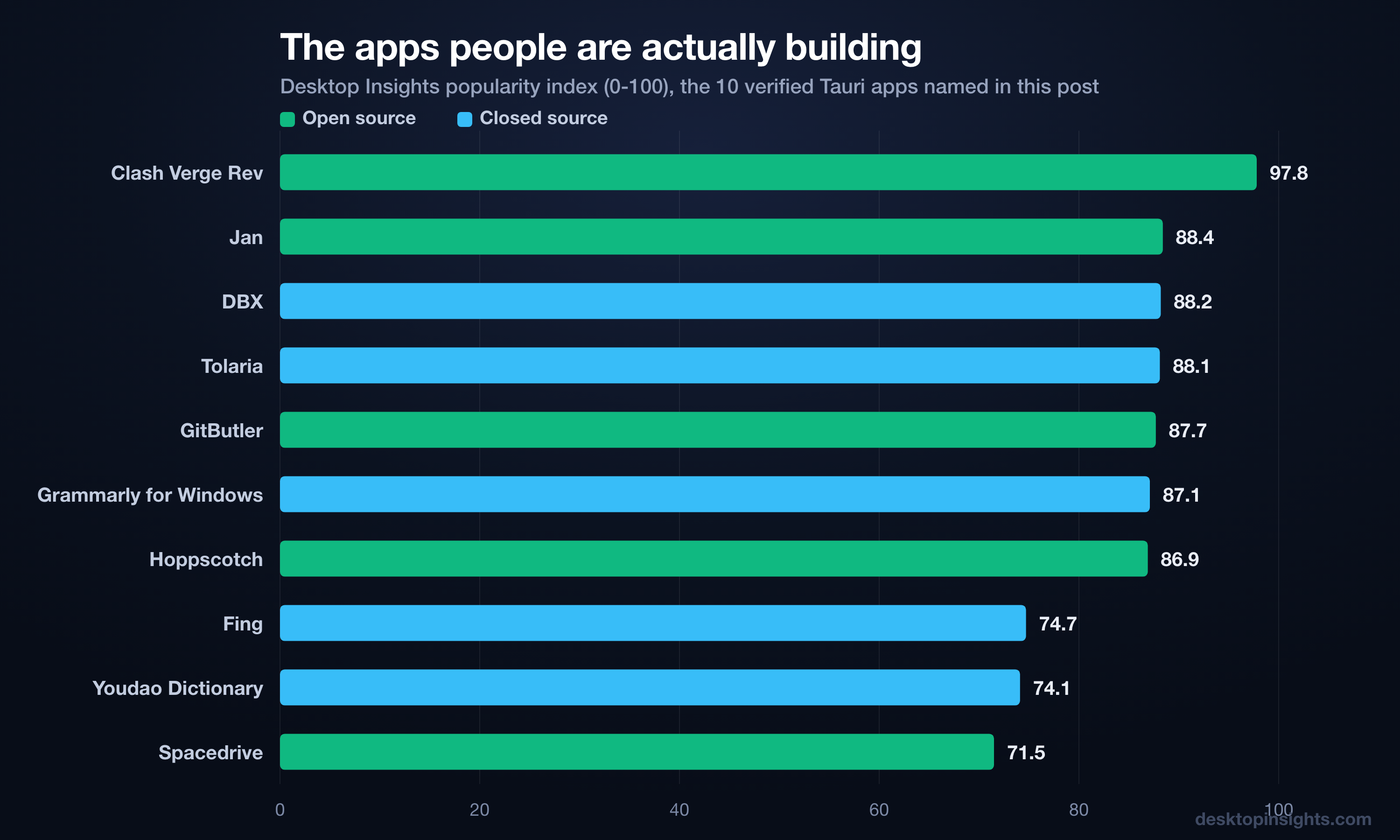
Each app below carries a Tauri, wry, or tao signal in its own dependency manifest and has a developer site that matches the app. High-scoring rows that failed either check are left out.
Open source, sorted by our popularity score:
- Clash Verge Rev, 97.8. GPL-3.0.
- Jan, 88.4. AGPL, a large GitHub following.
- GitButler, 87.7. Source-available.
- Hoppscotch, 86.9. MIT-licensed core.
- Spacedrive, 71.5. AGPL-3.0.
Closed source, where we could confirm both the framework and a genuine commercial product behind it:
- Grammarly for Windows, 87.1. A company the size of Grammarly built its Windows app on Tauri, which we did not expect.
- Fing, 74.7. An established commercial network-scanning tool.
- Youdao Dictionary, 74.1. NetEase's commercial translation app, well known in China.
Two more, DBX and Tolaria, pass the same checks but neither has enough of a public footprint for us to independently vouch for what they are beyond what their own sites say.
Where this stops being data
Every figure above is a single August 2026 snapshot, read from the Mach-O executable or PE file and everything bundled beside it, rather than a source repo or a store listing. We do not yet have a second dated corpus to diff against, so nothing here is a claim about Tauri's trajectory, only about where it sits. We will pull this again once there is something to compare it to. Want the same breakdown for a different runtime or vendor portfolio? Come ask us.