
We collect Mac apps from the Mac App Store, Homebrew, and direct developer downloads, then download each one and read the shipped binary: the Mach-O executable and the frameworks and libraries beside it. We infer the runtime from what the app actually links and bundles, not from a source repo or a published manifest. Only 1,457 of the apps we track are open source, so for the rest the binary is the only record of what they run.
Here is what they are built with, June 2026.
Swift and Objective-C still own the Mac. Well over half are native to the platform, and Electron is a distant second.
The Mac runtimes, ranked
Share of the Mac apps we track.
Swift / Obj-C, 57.2% (6,156). Cocoa and the system frameworks. The lightest dependency load in the ranking, a median of 3, and the smallest footprint at a median 21.1 MB.
 Raycast
 iTerm2
 Ghostty
 Final Cut Pro
 OrbStack
Electron, 19.4% (2,085). Bundles its own Chromium and Node. Median 406.9 MB, against a 59.5 MB median for Mac apps of any kind.
 VS Code
 Obsidian
 Cursor
 Postman
 Slack
SlackTauri, 7.7% (827). Rust plus the system webview. Already ahead of Qt, and at a median 26.2 MB it is roughly a fifteenth the size of the median Electron app.
 GitButler
 Spacedrive
 Hoppscotch
 Stremio
 Yaak
YaakQt, 4.2% (447). The mature C++ cross-platform toolkit, still shipping serious tools. Heavier on disk, a median of 149.3 MB.
 Wireshark
 VirtualBox
 KeePassXC
 Nextcloud
 Raspberry Pi Imager
Rust native, 2.1% (221). Rust used for the whole app, not the backend of a webview shell. Small but real, and part of the same Rust-on-the-Mac story as Tauri.
 Alacritty
 Zed
Zed Sniffnet
 Espanso
 Rio
RioThe long tail
Python, 2.1% (221). Apps written in Python, shipped with a bundled CPython interpreter. Mostly cross-platform developer and creative tools.
 calibre
 Meld
Meld Thonny
 qutebrowser
 Electrum
Flutter, 1.9% (202). Google's UI toolkit, one codebase from phone to desktop. On the Mac it skews to utilities and security apps.
 LocalSend
 RustDesk
 Cloudflare WARP
 Yubico Authenticator
 AppFlowy
Unity, 1.6% (176). The game engine. On the Mac App Store it is almost entirely casual games, many of them ports from mobile.
 Mahjong Solitaire Epic
 Solitaire Epic
 Jigsaw Puzzle Epic
 Code Of War
 Truck Simulator
JVM, 1.6% (174). Java and Kotlin on the desktop, which on the Mac means developer tooling: IDEs, database clients, security tools.
 Android Studio
 IntelliJ IDEA
 Cyberduck
 PyCharm
 Burp Suite
Go, 1.3% (138). Compiled straight to a native binary, no separate runtime. On the Mac these are networking, sync, and self-hosted server tools.
 Syncthing
 Tailscale
 LocalAI
 Stash
Stash Unpackerr
Wails, 0.5% (59). Go's answer to Tauri, a Go backend behind the system webview. So far, small menu-bar utilities.
 WailBrew
 xbar
xbar GUI.for.SingBox
 Ntfstool
 Keymapp
CEF, 0.4% (43). The Chromium Embedded Framework: a native app hosting a Chromium view for part of its interface. Media and streaming apps lead.
 Spotify
 OBS Studio
 ONLYOFFICE
 GeForce NOW
 SketchUp
Which runtimes carry the popular apps
Share is one question. Popularity is another. We took our 0 to 100 popularity index and, for each runtime, set the typical app against its ten most popular.
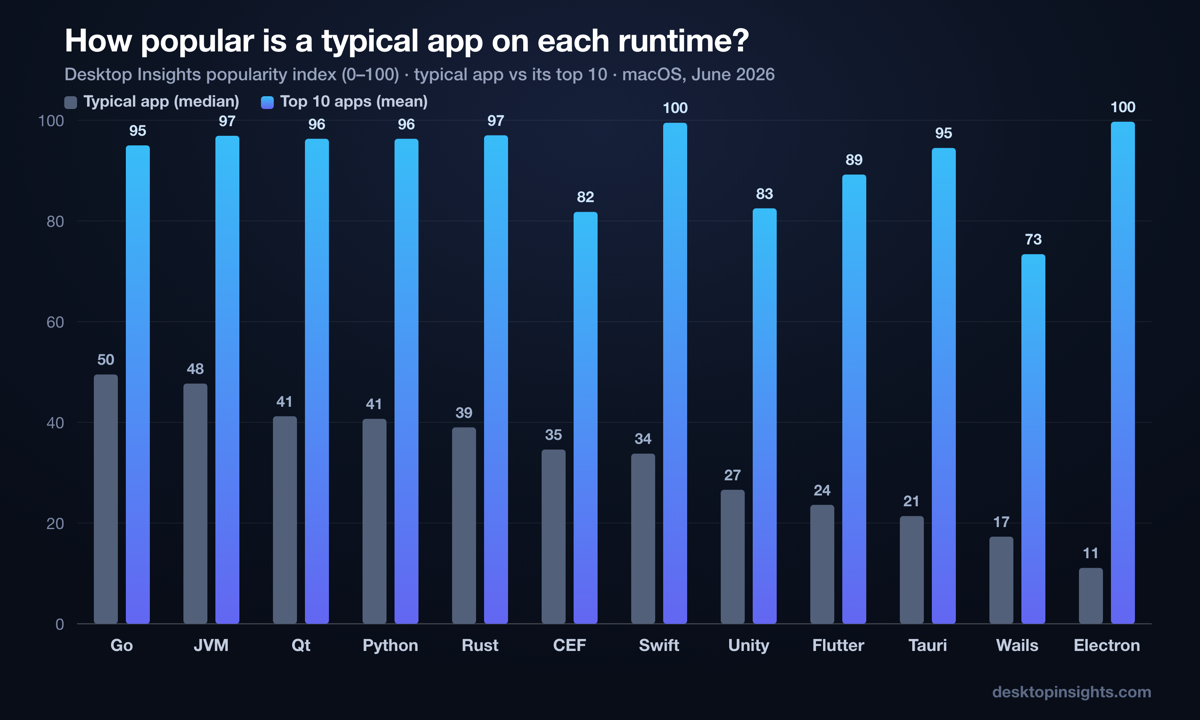
Every runtime has its hits. The flagship apps sit high across the board, from 73.4 for Wails to 99.7 for Electron, whether they run on a webview or compile to native. What separates the runtimes is the tail. The typical Go app scores 49.5 on the index; the typical Electron app, 11.1. Electron carries both the single most popular app we track and the most forgettable median, because it is the default anyone reaches for, and most of what ships on it never finds an audience.
Apple Silicon
16.1% of these apps still ship Intel-only, five years after the M1. 26.7% are Apple-Silicon-only, and the rest ship a universal binary. The holdout is the long tail no one has rebuilt.
Where the data comes from
Every figure is a June 2026 snapshot, measured by reading the shipped binary rather than a source repo or store listing. Most of these apps are closed source, so the shipped binary is the only place this information exists. The example apps under each runtime are the most popular we track for it. Want a custom cut, or the per-app data behind any of these numbers? Come ask us.